
PageSpeed Insights vs SpeedVitals: Which tool should you use?
Updated 14th March 2026
Run a Google PageSpeed Test for Your Website (Free Tool Below)
⚠️MOST WEBSITES SCORE UNDER 50
HOW ABOUT YOURS?
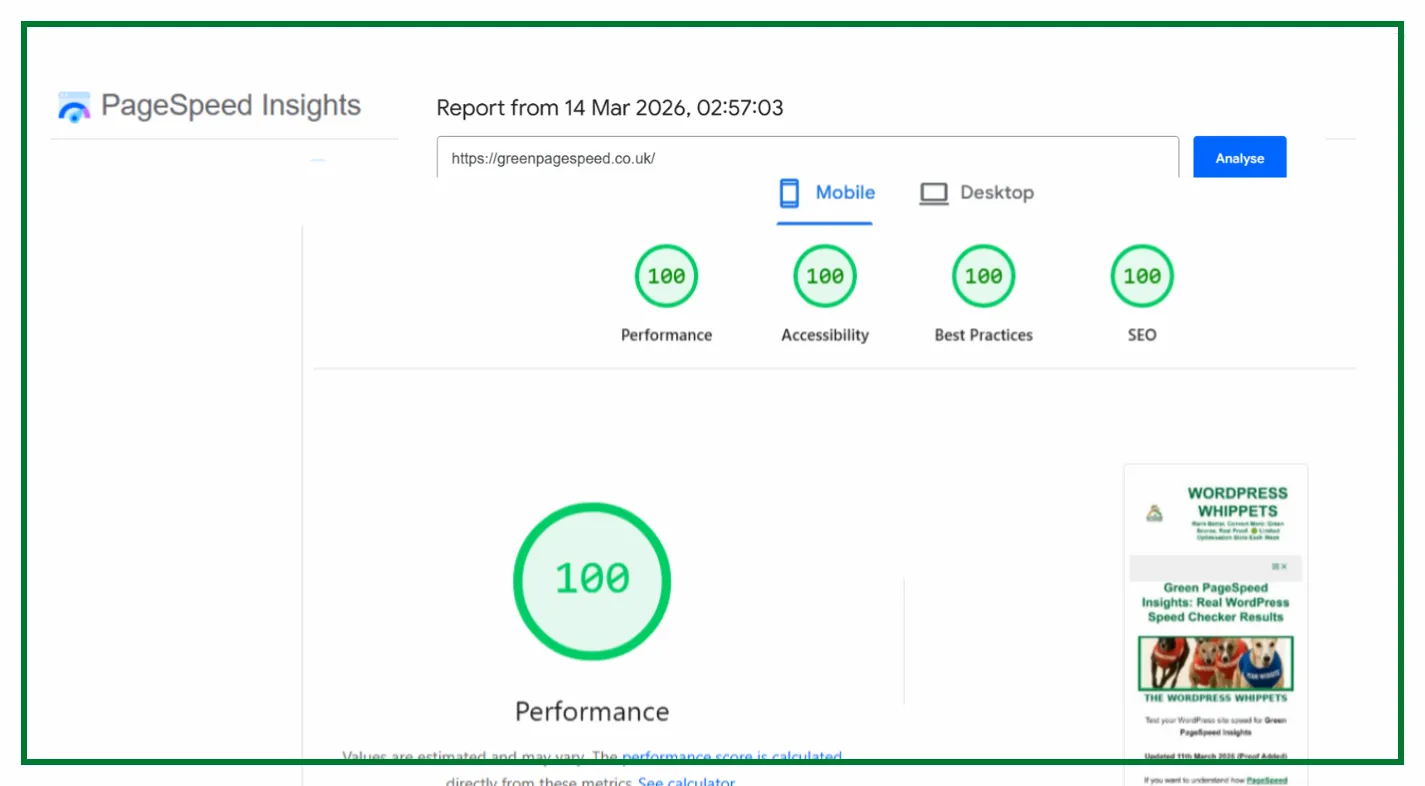
✅ Independently verified by Google PageSpeed
Try a FREE website speed check below
🔗 TEST YOUR SITE SPEED NOW
**PSI is a testing tool, not an endorsement.**
A genuine endorsement of our performance work
You can read the official WPX appraisal below.
WPX APPRAISAL
One Job P/Day =FULL FOCUS
We only take on one website per day, because rushing speed work doesn’t cut it.
Your site gets our full focus, and every detail is tuned for performance.
This hands-on approach consistently changes your PSI scores to green. It boosts Google rankings.
Click to see the green PageSpeed tests proof wall and scroll down slightly.
You will attract more traffic, more visibility, and ultimately, more business.
However, the good news is that once you know how to use Google PageSpeed Insights properly,
You’ll uncover exactly what’s dragging your site down and how to fix it for good.
Afterwards, look at the homepage and check out the full service that delivers the results shown on the “Live Results” page. (Updated Daily)
You pay upfront, and we do the work fast.
There are no hidden costs.
✅ Mobile-first
✅ Core Web Vitals fixed
✅ Google Green scores achieved
✅ Before & after proof
✅ 100% UK-based, WordPress-only service
✔️ GREEN SCORES, OR YOUR MONEY BACK✔️
“Can you guarantee I’ll get green PageSpeed Insights scores?”
Without a doubt, we guarantee a significant speed boost.
Most clients achieve scores of 90–100 on Google PageSpeed Insights.
If we fail to deliver green results across the core metrics, you’ll receive a full refund.
Our daily proof results reinforce these real scores.
Because when it comes to testing website performance, there’s no shortage of tools.
However, you may well find yourself comparing some of them,
However, they approach testing differently.
If you’re a website owner, developer, or business looking to make sure your site runs lightning-fast,
Well, you’ve probably asked yourself: which tool gives me the more reliable picture?
I run speed optimisation tests daily, not just occasionally.
That means I see patterns, strengths, and weaknesses across all the major tools.
And today, we’ll dive deep into PageSpeed Insights vs SpeedVitals to see which one you should rely on most.
We host Green Page Speed on WPX — fast, secure, and independently tested in all our PageSpeed proofs.
Try WPX Hosting→ (affiliate link)
What is PageSpeed Insights?
PageSpeed Insights (PSI) is Google’s own performance testing tool.
It grades websites on a 0-100 scale using Lighthouse, with a score of 90 or more considered “green” and passing the Core Web Vitals.
What makes PSI unique:
-
It’s backed by Google itself, which means its metrics directly tie into SEO rankings.
-
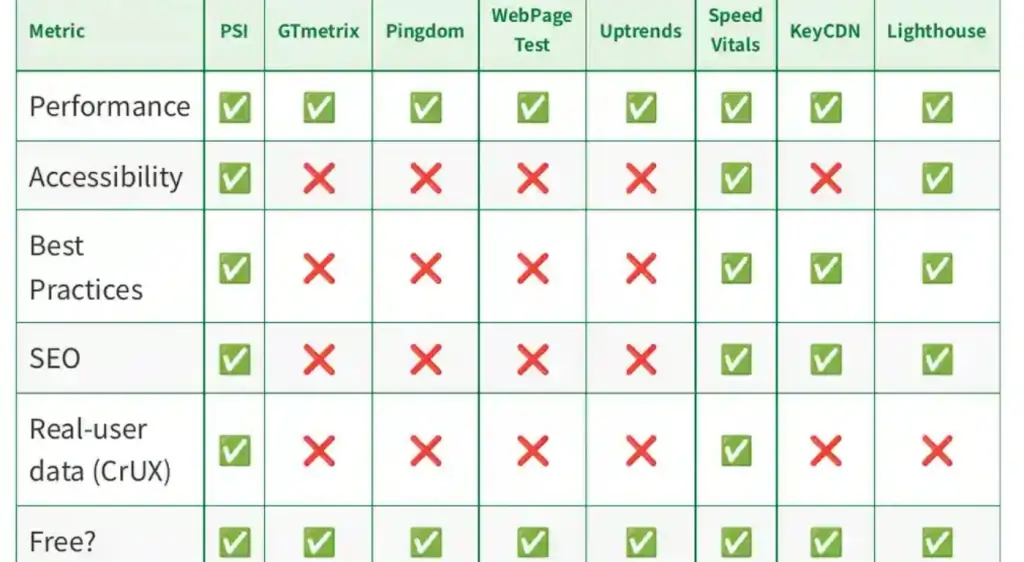
It measures the “big three” Core Web Vitals: Largest Contentful Paint (LCP), Cumulative Layout Shift (CLS), and Interaction to Next Paint (INP).
-
It pulls in real-user data from the Chrome User Experience Report (CrUX) when available, giving you insight into how actual visitors experience your site.
In other words, PSI isn’t just a test – It’s a window into the metrics Google themselves are watching when ranking your site. That’s why, for me, it’s always the number one speed tool.
What is SpeedVitals?
SpeedVitals is a newer tool, but it has gained attention from the layers it adds on top of Lighthouse.
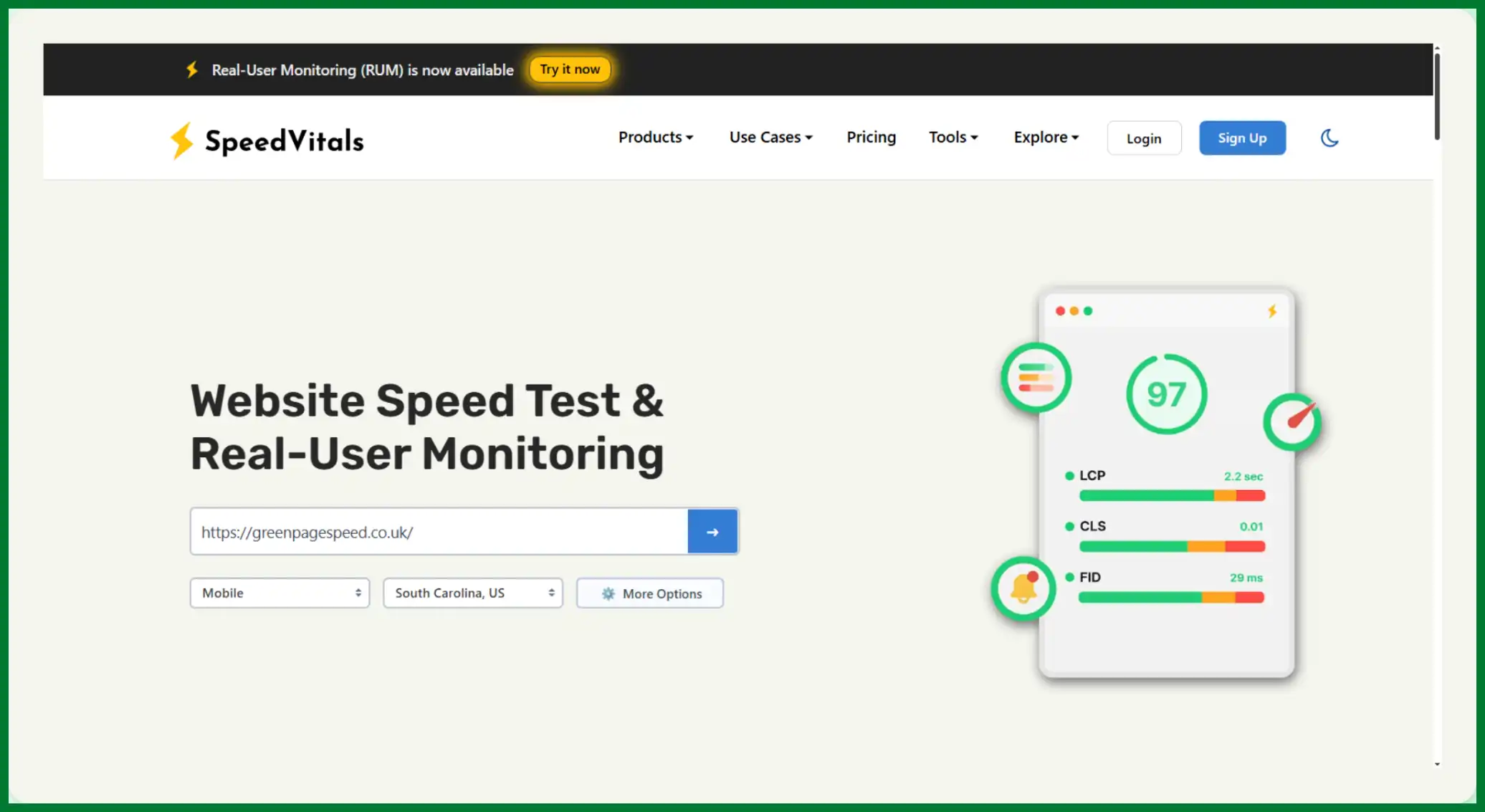
Here is the link to the SPEED VITALS tool.
What makes SpeedVitals unique:
-
You can test your website from multiple locations: You can see how your site loads around the world, not just from one server.
-
Deeper breakdowns of TTFB (Time to First Byte), waterfalls, and render timings.
-
Device-specific testing, with a strong focus on realistic mobile simulation.
-
A strict grading system: Even a slight inefficiency can drop your score compared to PSI.
In short, SpeedVitals is more like a developer’s lab. It’s stricter, less forgiving, and fantastic for fine-tuning details once you’ve already achieved a solid PSI score.
We Compared PageSpeed Tests, So You Don’t Have To
We’ve also compared PageSpeed Insights with other popular speed tools – check them out below:
Firstly, PageSpeed Insights: Mobile vs Desktop
Then
PageSpeed Insights vs DebugBear
Then
Also
PageSpeed Insights vs WebPageTest
And
PageSpeed Insights vs SpeedVitals
Also
PageSpeed Insights vs Uptrends
As well as
Finally
PageSpeed Insights vs Lighthouse
Let’s break it down and find out why PageSpeed Insights is still the best option in 2025
Head-to-Head: PageSpeed Insights vs SpeedVitals
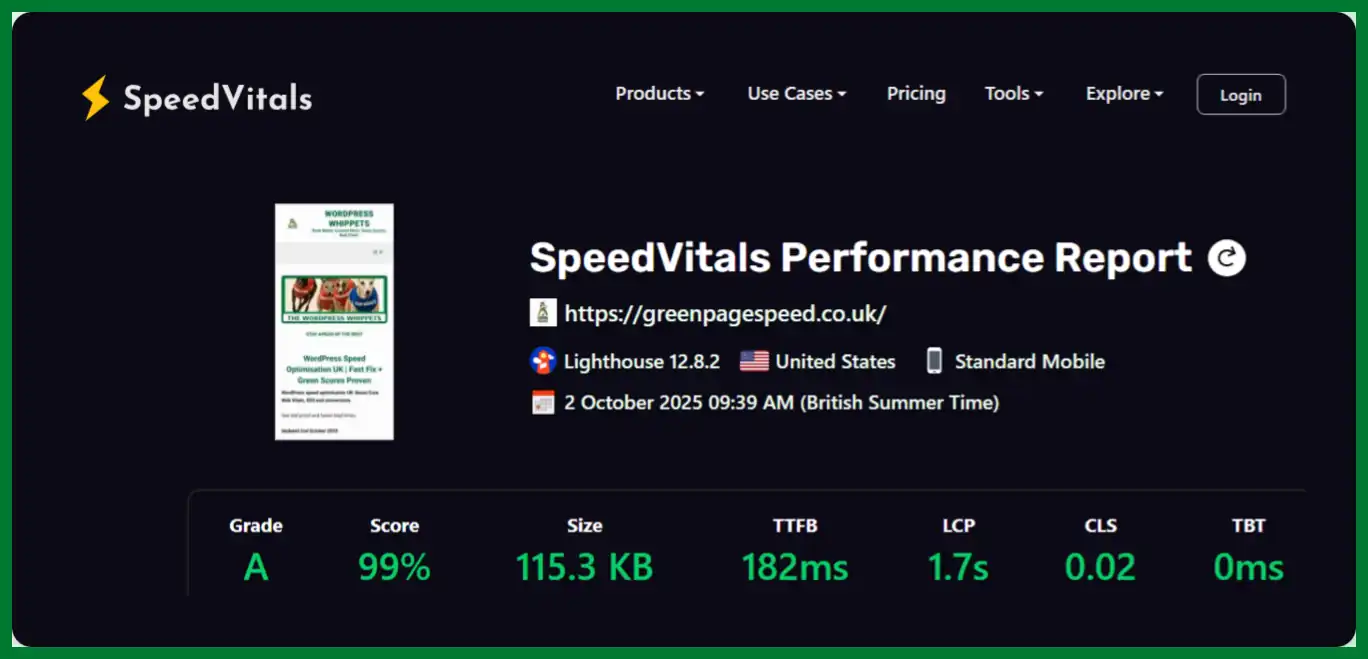
So how do the two compare when run against the same site? Here’s a real example from one of my recent tests:
📸 (Insert your SpeedVitals screenshot here with caption)
02/10/25 – SpeedVitals test: 99% Grade A, lightning-fast load time.
Even under SpeedVitals’ tougher grading, the site scored 99% Grade A, with:
-
TTFB: 182ms
-
LCP: 1.7s
-
CLS: 0.02
-
TBT: 0ms
And when tested in PageSpeed Insights? Also, 100/100 green across the board.
This head-to-head proves the key point: if a website performs well in PSI,
It nearly always performs well in SpeedVitals as well. But the reverse isn’t always true.
Passing SpeedVitals doesn’t guarantee Google’s PSI report will agree.
And since Google controls the rankings, PSI has to be your baseline tool of choice.
Strengths of PageSpeed Insights
-
SEO Relevance – PSI is tied directly into Google’s search engine. If you care about visibility, this is the report Google pays attention to.
-
CrUX Data – Only PSI shows real-world user data when available. That’s invaluable, because synthetic tests don’t always capture what live visitors are experiencing.
-
Simplicity – PSI’s clear 0-100 scoring system makes it easy for clients and businesses to understand at a glance.
When you show a client a green PSI score, it carries more weight than any other testing tool.
Strengths of SpeedVitals
-
Global Testing – Sites may perform differently in the US, UK, or Asia. SpeedVitals makes that obvious.
-
Strict Grading – It locates smaller inefficiencies that PSI might not penalise as heavily. That’s useful if you’re chasing absolute perfection.
-
Developer Focus – With waterfalls, TTFB per location, and thread blocking details, it’s brilliant for diagnosing edge-case performance issues.
If PSI is the standard everyone understands, SpeedVitals is the advanced lens for technical fine-tuning.
Which Tool Should You Trust More?
Here’s the truth: both tools matter. But if you had to pick one to focus on,
PageSpeed Insights should always be the priority.
Why? Because Google uses PSI’s metrics when ranking your site.
Passing Core Web Vitals in PSI means you’ve ticked the box that directly affects SEO.
SpeedVitals is an excellent tool for more insights, but it doesn’t influence rankings the same way PSI does.
Think of it like this:
-
PSI = your pass/fail grade with Google.
-
SpeedVitals = the advanced coaching that helps you refine even further.
Why This Matters for Businesses
Clients often ask: “Why should I care about these numbers?”
Well, read on then –
The answer is simple: a fast, stable site delivers three wins at once:
-
Higher rankings – Google rewards sites that pass Core Web Vitals.
-
Better user experience – visitors stay longer and bounce less when a site loads instantly.
-
More conversions – whether it’s sales, leads, or bookings, faster sites convert at higher rates.
That’s why at Green PageSpeed, we don’t just say a site is fast, we prove it daily across both PSI and SpeedVitals.
Final Verdict: PageSpeed Insights vs SpeedVitals
If you want the single most important speed score for your website, PageSpeed Insights wins.
It’s Google’s tool, tied directly to rankings, and it reflects the real-world Core Web Vitals.
These determine whether your site is SEO-friendly.
But dismissing SpeedVitals would be a mistake.
Its stricter grading and multi-location testing make it an excellent second opinion.
Together, PSI and SpeedVitals form a complete picture:
One tells you how Google sees your site, the other tells you how it performs across the wider web.
Call to Action
At Green PageSpeed, we’ve built something unique: Yes, we have a live proof wall.
It has over 100 daily tests on PageSpeed Insights. You won’t find this transparency at larger agencies.
When you’re ready to make your WordPress site as fast as ours, let’s talk.